Biochemistry
From questions to insights, 30online scientific tool. No registration required, free calculation and export.
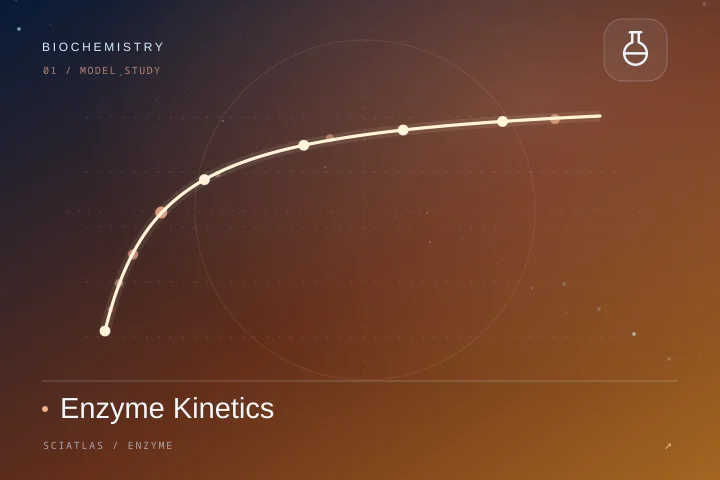
Enzyme Kinetics
fits Michaelis-Menten kinetics and inhibition models and compares experiments with predictions.
substrate and inhibitor concentrations use the same unit; the inhibition model requires multiple inhibitor concentrations. Locally linearized parameter intervals are not a substitute for experimental design.

Pathway Canvas
Edit nodes and reaction connections to map your own expression data to pathways.
custom network does not have built-in restricted KEGG data; the expression color does not represent the real flux. JSON can be edited and saved.
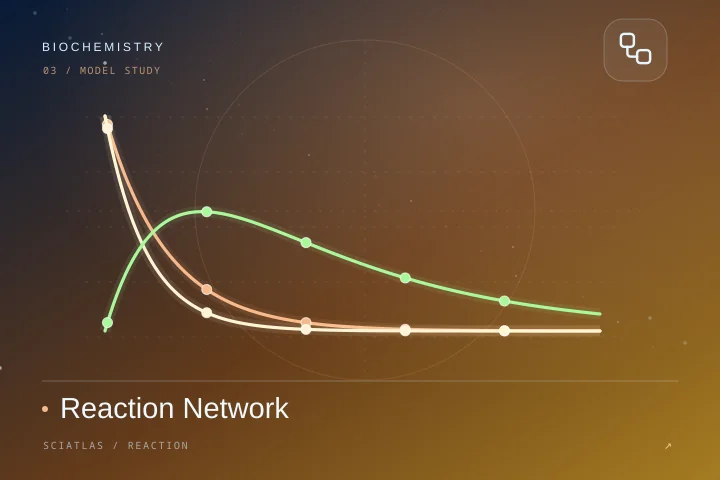
Reaction Network
simulates mass action dynamics and compares parameter changes with system response.
forward mass action model; stoichiometry is user-specified, arbitrary Python expressions are not accepted. Sensitivity is a finite perturbation of a specified rate constant.

Buffer pH
estimates pH based on the pKa of a weak acid and the concentration of conjugate acid and base.
activity is approximated by concentration and is applicable near the buffer range.

Stock Dilution
Calculates mother liquor and diluent volumes based on concentration conservation.
Volumetric, reaction-free and concentration process.
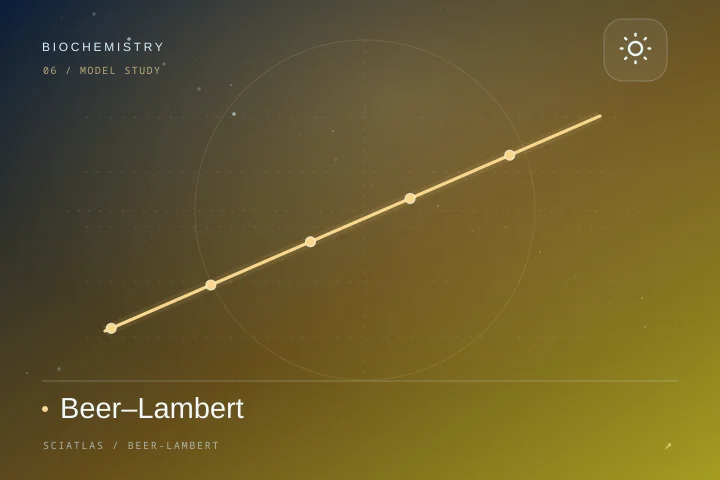
Beer–Lambert
uses molar absorption coefficient and optical path length to calculate concentration.
Dilute solution, monochromatic light, blanked and low scattering; nonlinearity requires calibration.
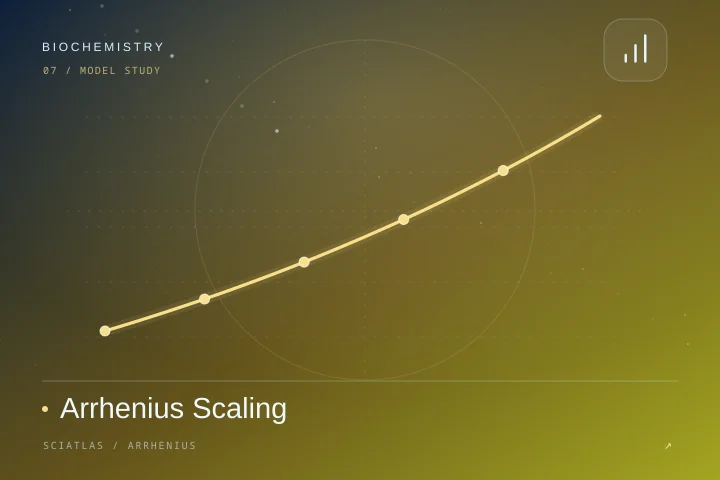
Arrhenius Scaling
Predict rate constants under temperature changes using reference rates and activation energies.
has the same reaction mechanism and constant activation energy, and can only be used in verified temperature zones.

Gibbs Equilibrium
relates standard free energy changes and dimensionless equilibrium constants.
standard state definition is consistent, thermodynamic activity balance; not kinetic rate prediction.
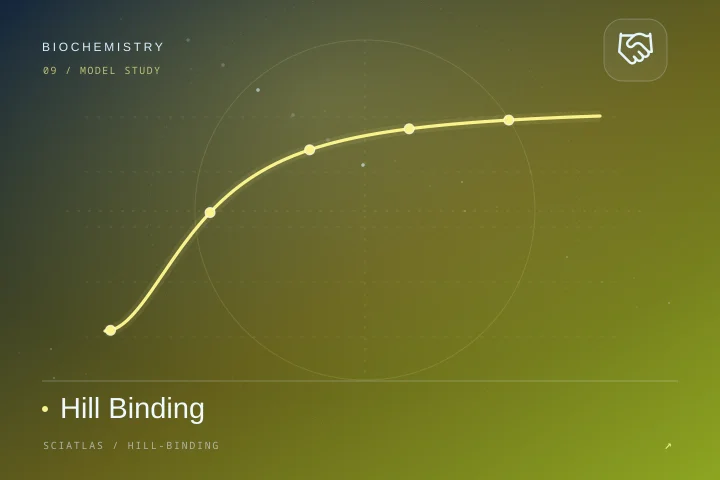
Hill Binding
plots ligand binding occupancy using synergy coefficients.
empirical occupancy model, the Hill coefficient cannot be directly regarded as the number of sites.

Competitive Inhibition
compares substrate initial velocity curves with and without inhibitors.
Simple reversible competitive inhibition, initial velocity and quasi-steady state, Vmax unchanged.
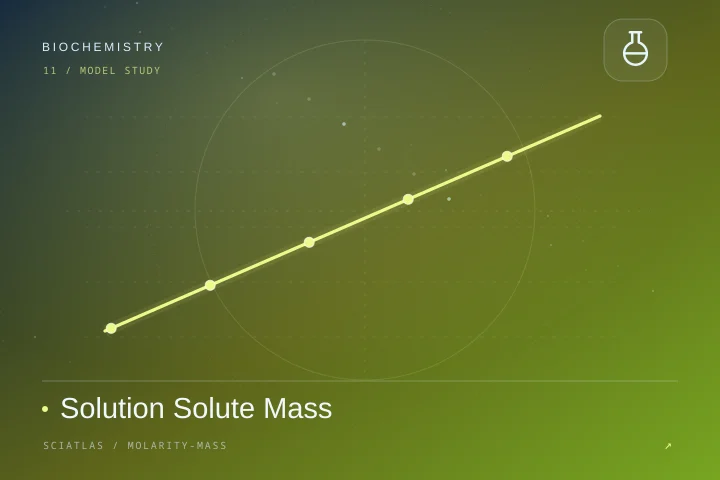
Solution Solute Mass
m=CVM: Calculate the liquid mass conversion based on the input, and provide local sensitivity curves and data export.
is calculated based on pure solute mass; hydrates, purity and moisture absorption need to be revised separately.
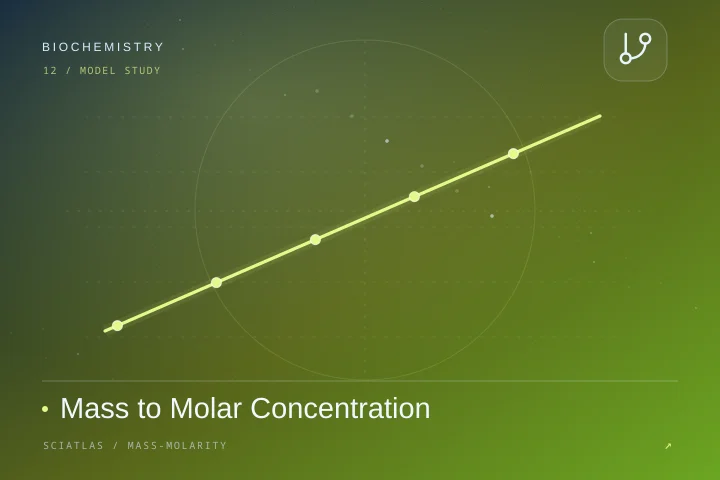
Mass to Molar Concentration
C=ρmass/M: Calculate the mass concentration to molar concentration based on the input, and provide local sensitivity curves and data export.
needs to be consistent with the actual chemical form.
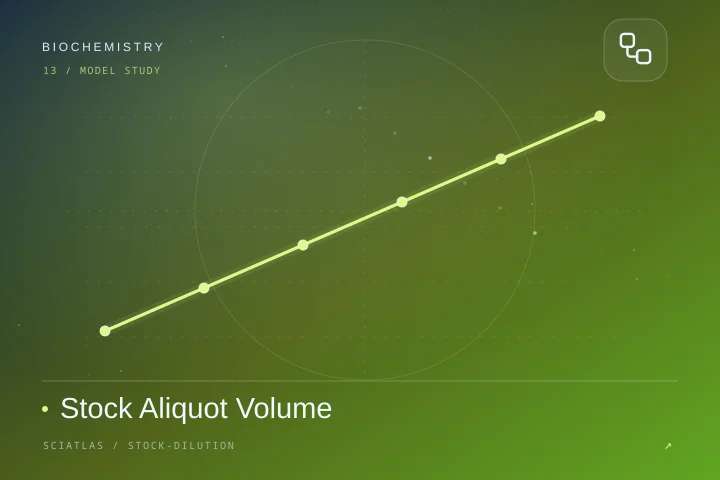
Stock Aliquot Volume
Vstock=Cfinal Vfinal/Cstock: Calculate the volume of mother liquor taken according to the input, and provide local sensitivity curve and data export.
is based on the final constant volume and does not assume strict addition of the mixed volumes.

Transmittance to Absorbance
A=−log₁₀T: Calculate transmittance to absorbance based on input, and provide local sensitivity curves and data export.
Enter the transmittance as a fraction and need to match the reference and wavelength.
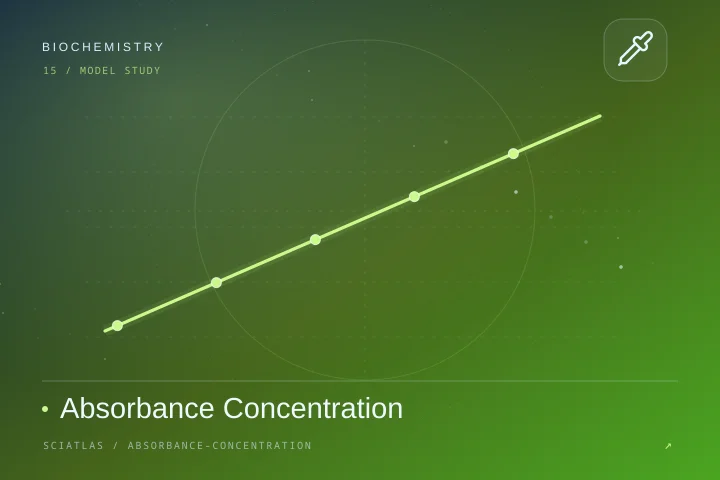
Absorbance Concentration
c=A/(εl): Calculate absorbance quantification based on input, and provide local sensitivity curves and data export.
Bier-Lambert linear range, no scattering and matrix interference.
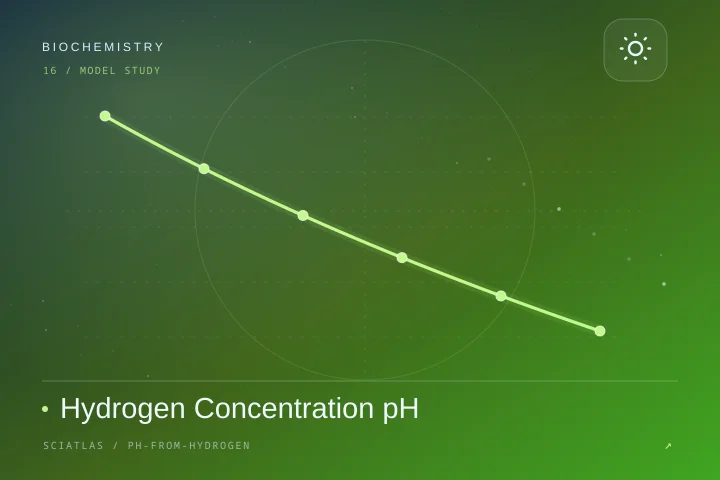
Hydrogen Concentration pH
pH≈−log₁₀[H⁺]: Calculate the hydrogen ion concentration to estimate the pH based on the input, and provide local sensitivity curves and data export.
Dilute solution activity coefficient is one; strict pH definition is based on activity.
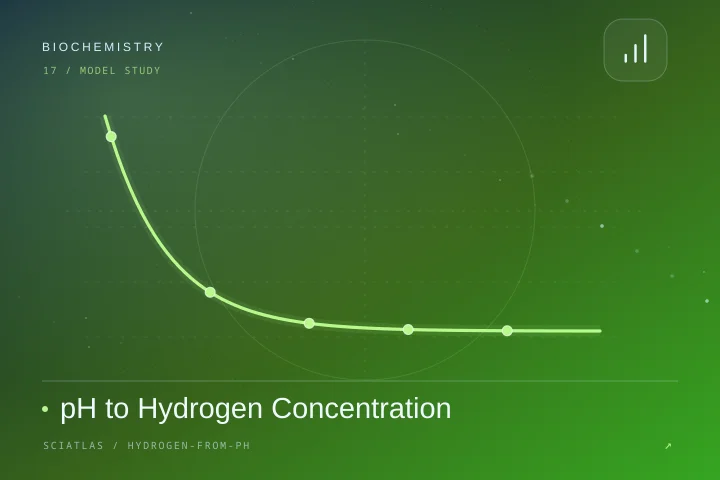
pH to Hydrogen Concentration
[H⁺]≈10^(−pH): Calculate the pH transfer hydrogen ion concentration based on the input, and provide local sensitivity curves and data export.
Dilute solution approximation, without activity coefficient.
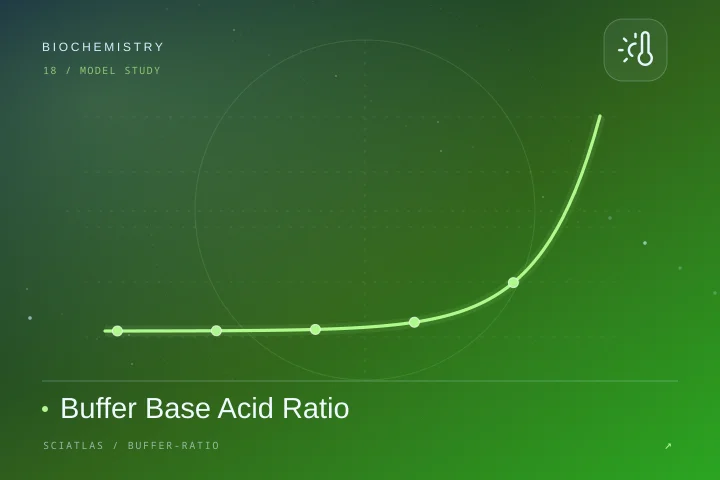
Buffer Base Acid Ratio
[A⁻]/[HA]=10^(pH−pKa): Calculate the alkali-acid ratio of the buffer based on the input, and provide local sensitivity curves and data export.
Henderson–Hasselbalch approximation, concentration instead of activity.
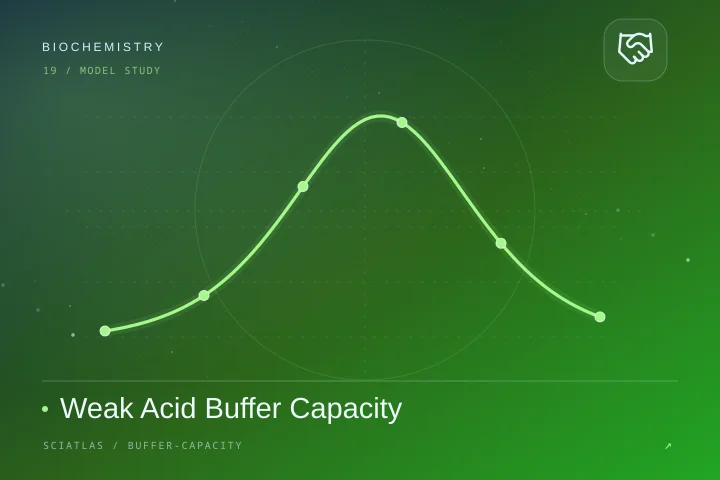
Weak Acid Buffer Capacity
β=ln10·C Ka[H⁺]/(Ka+[H⁺])²: Calculate the weak acid buffer capacity based on the input, and provide local sensitivity curves and data export.
only buffer pair contributions, ignoring water self-dissociation, activity and multiproton coupling.
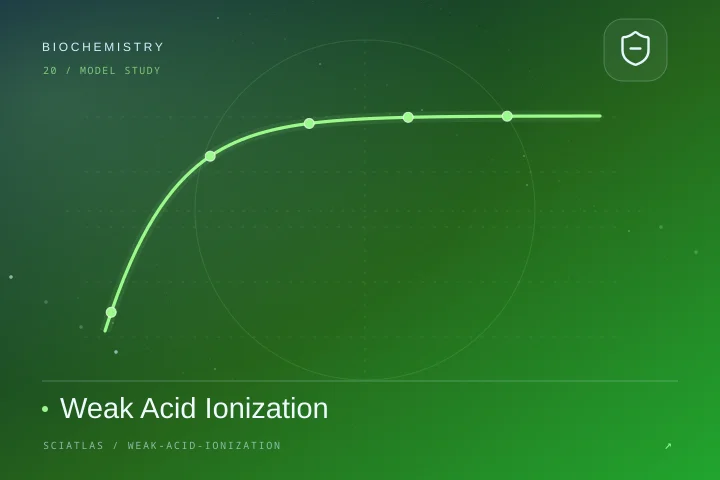
Weak Acid Ionization
f=1/[1+10^(pKa−pH)]: Calculate the dissociation ratio of weak acid based on the input, and provide local sensitivity curves and data export.
Single proton weak acid balance; not a prediction of transmembrane permeability or drug efficacy.
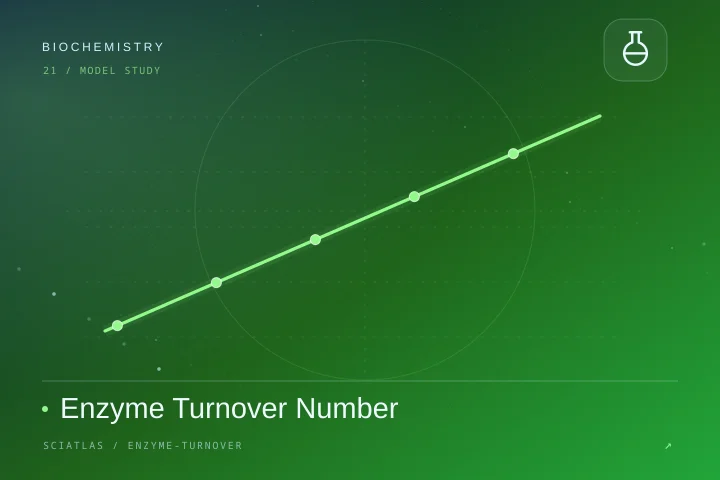
Enzyme Turnover Number
kcat=Vmax/[E]total: Calculate enzyme turnover number based on input, provide local sensitivity curve and data export.
Vmax and active site concentration need to be based on the same volume.

Catalytic Efficiency
η=kcat/Km: Calculate enzyme catalytic efficiency based on input, provide local sensitivity curves and data export.
Secondary efficiency parameter of low substrate approximation, not equal to diffusion constant.

Competitive Apparent Km
Kmapp=Km(1+I/Ki): Calculate the apparent Km of competitive inhibition based on the input, and provide local sensitivity curves and data export.
Fast balancing reversible competitive inhibition with unchanged Vmax.

Cheng Prusoff Ki
Ki=IC50/(1+S/Km): Calculate Cheng–Prusoff Ki based on the input, and provide local sensitivity curves and data export.
Simple competitive inhibition without significant ligand depletion; not universal for all IC50s.

Binding Free Energy
ΔG°=RT ln(Kd/c°): Calculates the standard free energy based on the input, and provides local sensitivity curves and data export.
Construct a dimensionless equilibrium constant with c°=1 mol/L, and the standard state depends on the convention.

Nernst Potential
E=E°−RT lnQ/(nF): Calculate the Nernst potential based on the input, and provide local sensitivity curves and data export.
is calculated according to the written reduction reaction and consists of commercial activity.

Van t Hoff Relation
ln(K₂/K₁)=−ΔH/R(1/T₂−1/T₁): Calculate the equilibrium constant temperature correction based on the input, and provide local sensitivity curves and data export.
The reaction enthalpy is approximately constant in the temperature range, and the dimensionless K adopts the same standard state.

Ideal Osmotic Pressure
π=iCRT: Calculate the osmotic pressure of dilute solutions based on input, and provide local sensitivity curves and data export.
Dilute solution approximation; electrolyte factors need to account for practical non-idealities.

Enzyme Specific Activity
SA=activity/protein: Calculate enzyme specific activity based on input, provide local sensitivity curve and data export.
Enzyme activity units are defined according to substrate, temperature and assay method.

Protein Purification Fold
fold=SAfinal/SAinitial: Calculate the protein purification fold based on the input, and provide local sensitivity curves and data export.
Two viability determinations must use comparable conditions; folds do not equal purity percentage.
Understand the method and then start calculating
Tools in this field provide runnable examples, model conditions and method descriptions. Please select a model that meets the experimental conditions and retain parameter and version information.
Connect knowledge with each other
Related disciplines and tools In the initial calculation of
Structural Biology ↗structure and molecular properties
Pharmacokinetics ↗Drug Binding and Metabolism
Microbiology ↗Microbial metabolism and growth