Return to tool library
Competitive Inhibition science theme cover
Competitive InhibitionAll functions are free

Competitive Inhibition

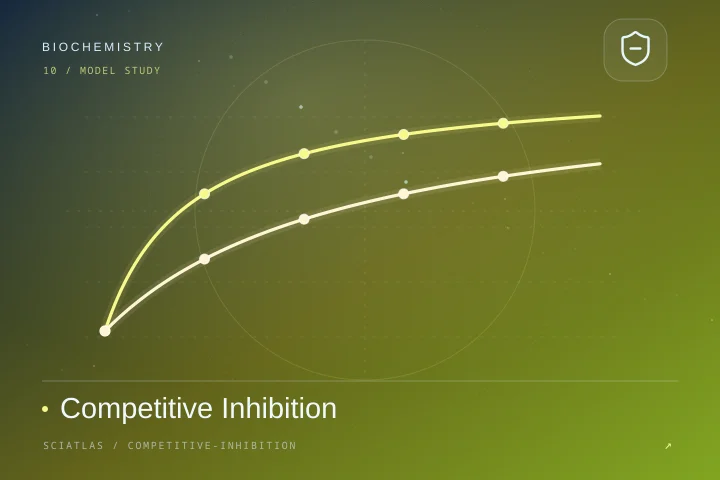
compares substrate initial velocity curves with and without inhibitors.

waiting for input
YOUR NEXT DISCOVERY STARTS HERE

A question, a new exploration.

sample parameters are ready. Run directly, or load your own data.

Simple reversible competitive inhibition, initial velocity and quasi-steady state, Vmax unchanged.

Competitive Inhibition: uses and methods

compares substrate initial velocity curves with and without inhibitors.

Applicable scope and calculation boundary

Simple reversible competitive inhibition, initial velocity and quasi-steady state, Vmax unchanged.

model and reference method

v=Vmax S/[Km(1+I/Ki)+S]

model version: 1.1.0. The results are used for scientific research, exploration and teaching, please interpret according to the model conditions.

input parameters

Vmax(μM/min)
Value range: 0.000001 – 1000000
Km(μM)
Value range: 0.000001 – 1000000
Ki(μM)
Value range: 0.000001 – 1000000
inhibitor concentration(μM)
Value range: 0 – 1000000

How to use

  1. Load the example or enter data that matches the field description.
  2. Confirm units and models, run calculations and check diagnostics.
  3. Export charts, tables or results packages and record model versions.

tools in the same field

are free and open; free sponsorship does not affect tool permissions. All functions of Read scientific methods and data explanations 。

FROM SCIENCE TO PRACTICE

commercial application case

Industry Application · Independent Reproduction Example

Competitive Inhibition

enzyme development team examines the impact of the competitive inhibition hypothesis on muzzle velocity.

Public industry reference: EMBL

The institution’s public research directions include: Molecular biology, biochemical mechanism and system scale research. This link serves as a portal for field background and extended learning.

View product or organization original information

on this site

  1. Load the default example of Competitive Inhibition and check Vmax、Km、Ki and its units.
  2. is calculated using v=Vmax S/[Km(1+I/Ki)+S], and the results are compared after adjusting a single parameter.
  3. checks applicable conditions and diagnostics, and exports numerical tables, charts, and model versions for review.

Deliverables

compares substrate initial velocity curves with and without inhibitors. delivers parameter records, calculation charts, and reproducible JSON result packages.

needs to be checked before landing

Simple reversible competitive inhibition, initial velocity and quasi-steady state, Vmax unchanged.。

case is compiled for public industry purposes, and the reproduction steps are independent examples of this site; it does not mean that the above-mentioned institutions use or endorse this site, nor does it cite customer benefits that have not been publicly verified. The

SEE THE PRINCIPLE IN MOTION

scientific animation demonstration

Scroll to load calculation example…
FOLLOW THE RESEARCH

recommended by universities and research institutions

Biochemistry

The following is the recommended reading order of this website organized by direction relevance, public research resources and learning portals. The number is the serial number recommended by the editor, not QS, THE or paper measurement ranking; it does not represent the overall strength of the institution.

  1. 01

    EMBL

    Europe

    Molecular biology, biochemical mechanism and system scale research。

    official website link accessibility check: 2026-10-03
  2. 02

    Max Planck Institute of Biochemistry

    Germany

    Protein function, cellular mechanism and biochemistry。

    official website link accessibility check: 2026-10-03
  3. 03

    University of Oxford · Department of Biochemistry

    United Kingdom

    Molecular mechanism, metabolism and structural biochemistry。

    official website link accessibility check: 2026-10-03

catalog compiled on 2026-10-03. Link accessibility does not equate to verification of the latest papers, admissions, or program status; please check the institution's official website for specific research teams and opportunities.

CONNECTED SCIENCE

Connect knowledge with each other