Materials & Crystals
From questions to insights, 30online scientific tool. No registration required, free calculation and export.
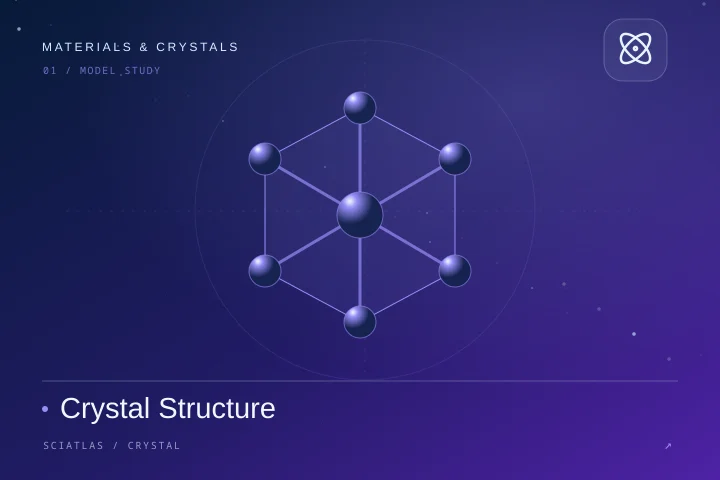
Crystal Structure
View unit cells and supercells online, measure atomic distances, bond angles and dihedral angles.
supports CIF and direct coordinate/Cartesian coordinate POSCAR; CIF expansion space group symmetry operation. Some occupancies are displayed as entered and unordered microstructure is not inferred.
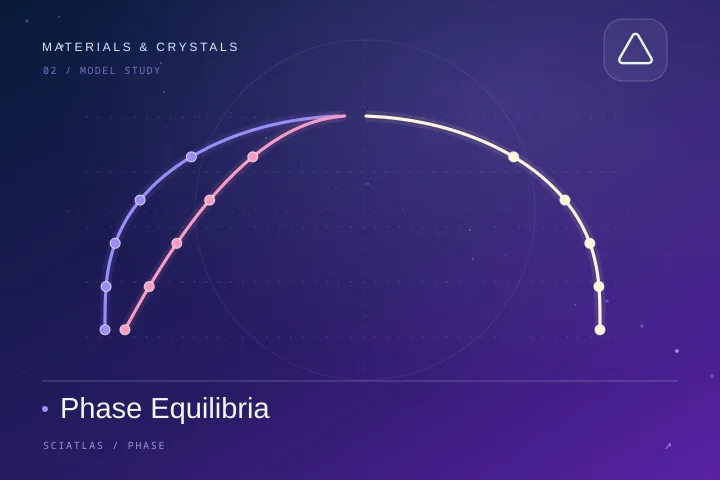
Phase Equilibria
Use regular solution free energy to explore miscibility gaps and ternary composition spaces.
Binary symmetry regular solution model; ternary is single-phase regular solution free energy and local stability, and does not output the complete ternary coexisting phase equilibrium.
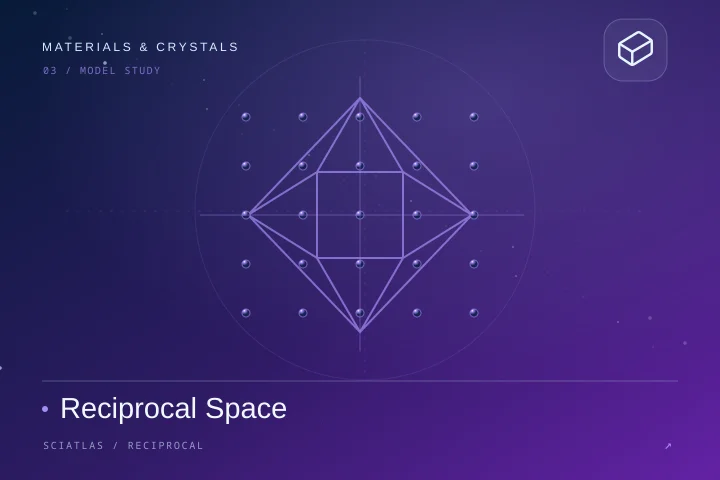
Reciprocal Space
constructs the reciprocal lattice, first Brillouin zone and interplanar spacing from the unit cell.
General triclinic unit cell; the first Brillouin zone is intersected by the nearest reciprocal point half space. Diffraction only gives the geometric peak positions and does not calculate the structure factor intensity.
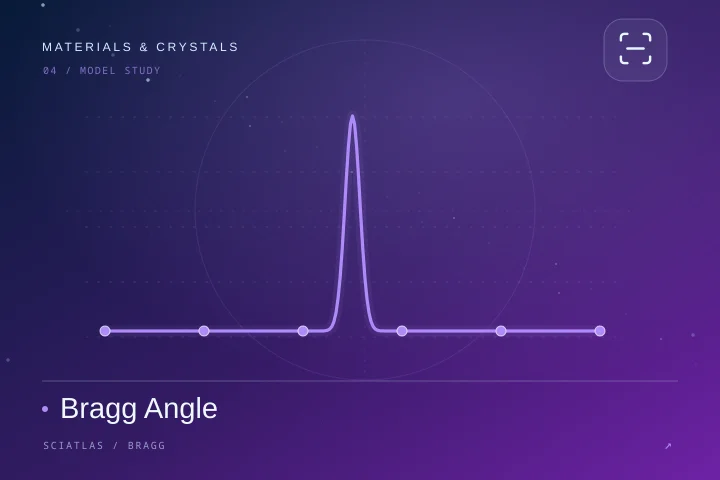
Bragg Angle
Calculate the diffraction peak position from the interplanar spacing and wavelength.
Single crystal plane, elastic coherence diffraction; the peak shape shown is for labeling only.
Scherrer Size
Estimating coherent diffraction domain size from peak broadening.
dimensional broadening dominates, Gaussian instrument broadening squared error correction; microstrain needs to be considered separately.
Crystal Density
Calculates density from unit cell volume, formula weight and number of chemical formulas per cell.
is an ideal crystal with complete space occupation and no pores; Z must be consistent with the unit cell used.
Thermal Expansion
estimates free elongation and fully constrained thermal stresses caused by temperature differences.
constant expansion coefficient, linear elastic small strain; constrained stress is a one-dimensional fully constrained upper limit model.

Fick Diffusion Profile
Computes the complementary error function diffusion solution at constant surface concentration.
Semi-infinite one-dimensional medium, constant D, initial uniform concentration.
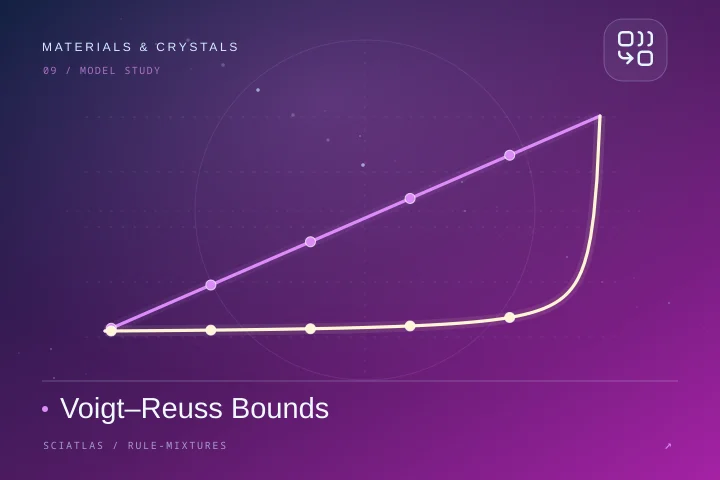
Voigt–Reuss Bounds
Compares the iso-strain and iso-stress modulus bounds of two-phase composites.
The ideal two-phase linear elastic limit cannot determine the true modulus of any microstructure.
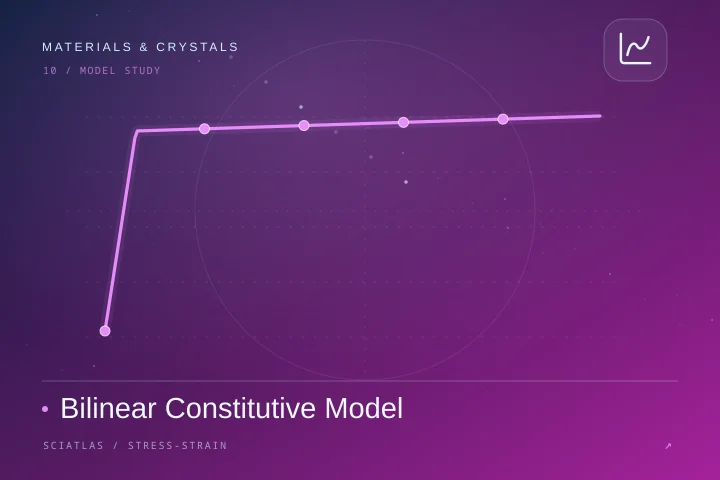
Bilinear Constitutive Model
Observe the ideal monotonic loading curve of elastic yielding and linear hardening.
One-dimensional monotonic stretching, does not handle unloading, cycling and fracture.
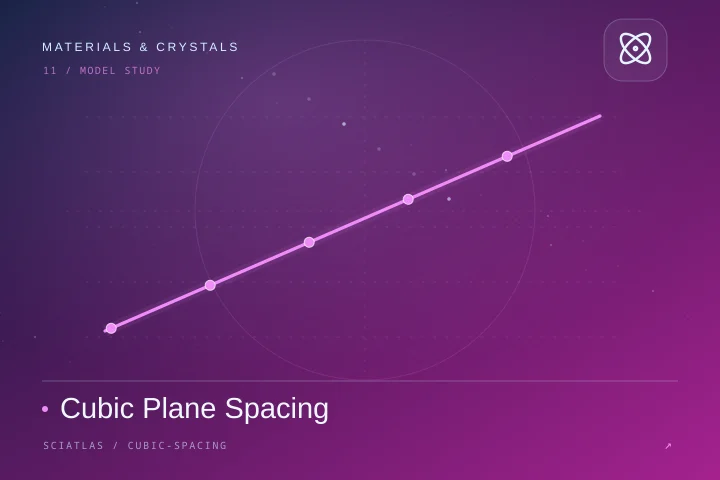
Cubic Plane Spacing
d=a/√(h²+k²+l²): Calculate the interplanar spacing of cubic crystals based on the input, and provide local sensitivity curves and data export.
is for cubic unit cells only, the Miller exponent is an integer and cannot be all zeros.
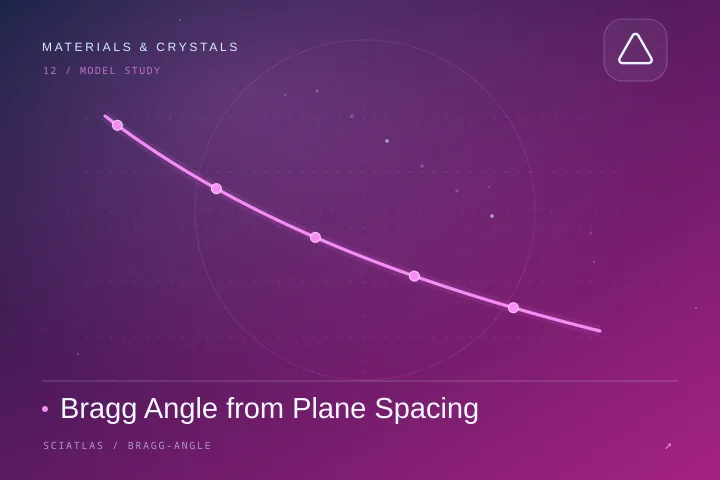
Bragg Angle from Plane Spacing
2θ=2asin(λ/2d): Calculate the crystal plane spacing to diffraction angle based on the input, and provide local sensitivity curves and data export.
First-order Bragg diffraction requires λ≤2d.
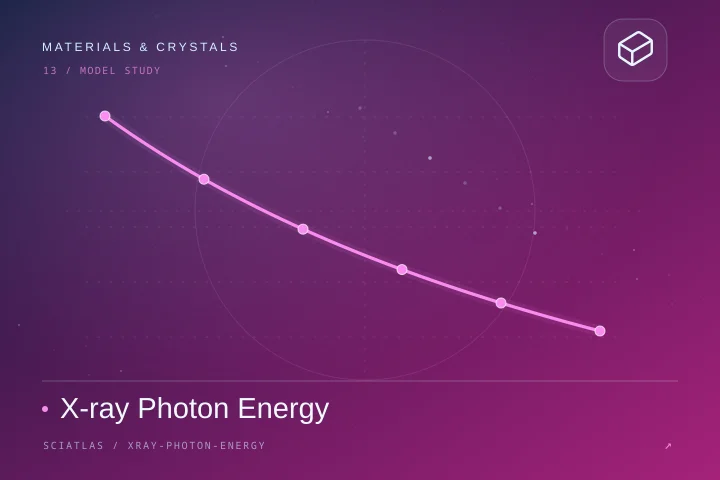
X-ray Photon Energy
E=hc/λ: Calculate X-ray photon energy according to input, provide local sensitivity curve and data export.
Vacuum photon energy wavelength conversion.

Lattice Microstrain
ε=(a−a₀)/a₀: Calculate lattice microstrain based on input, and provide local sensitivity curves and data export.
One-dimensional average strain, excluding instrument peak position error.
Equilibrium Vacancy Fraction
cv=exp(−Qv/kBT): Calculate the equilibrium vacancy fraction based on the input, and provide local sensitivity curves and data export.
rare vacancy approximation, neglecting the formation entropy term and non-equilibrium defects.
Diffusion RMS Length
xrms=√(2Dt): Calculate the diffusion root mean square length based on the input, and provide local sensitivity curves and data export.
One-dimensional constant diffusion coefficient random diffusion.

Arrhenius Diffusivity
D=D₀exp(−Q/RT): Calculate the diffusion coefficient temperature relationship based on the input, and provide local sensitivity curves and data export.
is a single heat-activated diffusion mechanism, and the parameters require material calibration.
Hall Carrier Density
n=1/(e|RH|): Calculate the Hall carrier concentration based on the input, and provide local sensitivity curves and data export.
single carrier model, input the absolute value of Hall coefficient.

Drude Conductivity
σ=neμ: Calculate the Drude conductivity based on the input, and provide local sensitivity curves and data export.
is a single carrier type and the parameters do not change with the electric field.
Sheet Resistance
Rs=ρ/t: Calculate thin film sheet resistance based on input, provide local sensitivity curve and data export.
is a uniform continuous film, ignoring contact resistance and size effects.
Thermal Diffusivity
α=k/(ρcp): Calculate thermal diffusivity based on input, provide local sensitivity curve and data export.
isotropic and constant material.
Slab Thermal Resistance
R=L/(kA): Calculate the thermal resistance of the material plate based on the input, and provide local sensitivity curves and data export.
Steady one-dimensional thermal conductivity, no contact thermal resistance.
Gibbs Thomson Shift
ΔT=2γTm/(ρLr): Calculate the Gibbs Thomson melting point shift based on the input, and provide local sensitivity curves and data export.
Spherical particle continuum approximation; very small nanoparticles are not guaranteed to be effective.
Hall Petch Strength
σy=σ₀+k/√d: Calculate the Hall Page yield strength based on the input, providing local sensitivity curves and data export.
Conventional grain range empirical relationship; ultra-fine nanocrystals may deviate.
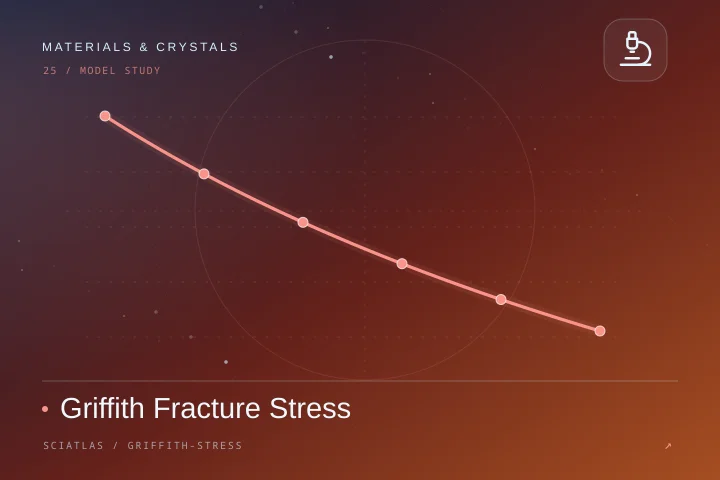
Griffith Fracture Stress
σc=√(2Eγ/πa): Calculate the Griffith fracture stress based on the input, and provide local sensitivity curves and data export.
Infinite plate center crack, ideal brittleness, plane stress approximation.
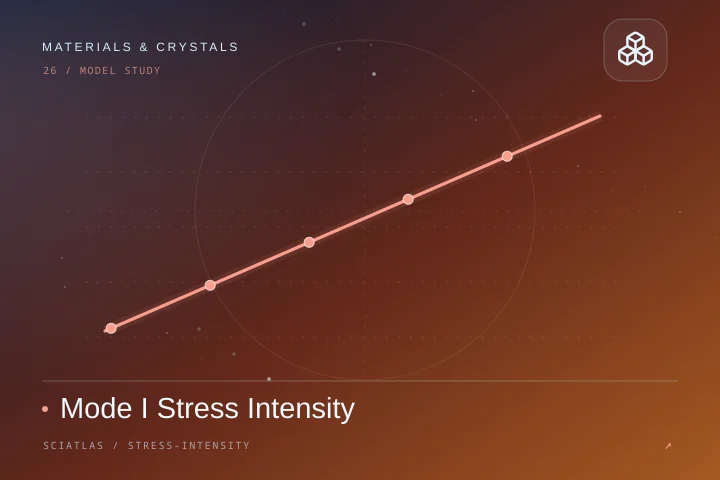
Mode I Stress Intensity
KI=Yσ√(πa): Calculate the type I stress intensity factor based on the input, and provide local sensitivity curves and data export.
Linear elastic fracture mechanics; geometric coefficients need to be selected for the sample.
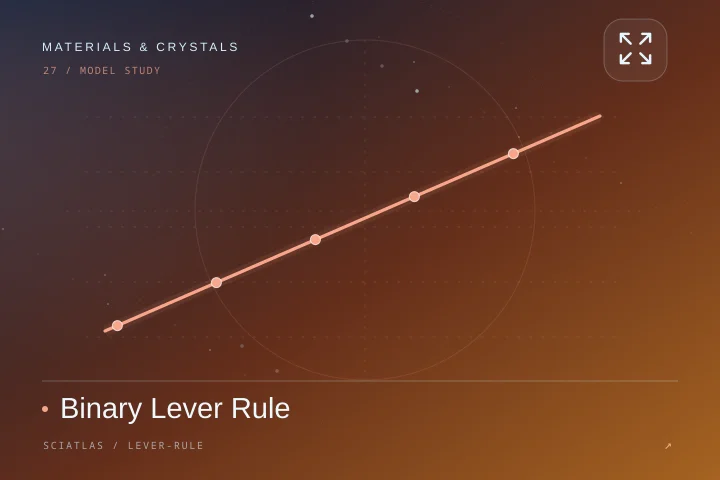
Binary Lever Rule
fβ=(C₀−Cα)/(Cβ−Cα): Calculate the lever rule of the binary phase diagram based on the input, and provide local sensitivity curves and data export.
Two-phase equilibrium line range, the input must use the same mass or molar basis.
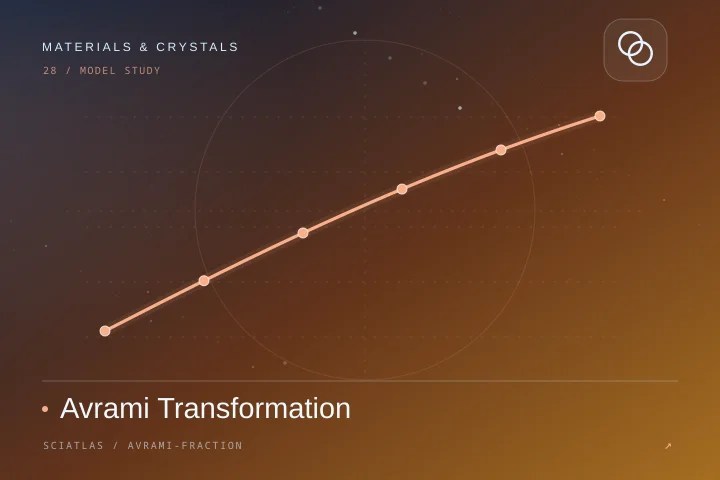
Avrami Transformation
X=1−exp(−ktⁿ): compute Avrami Transformation from inputs, with local sensitivity plots and data export.
Isothermal empirical crystallization kinetics, not applicable to all phase transition mechanisms.

Brinell Hardness
HBW=0.102·2F/[πD(D−√(D²−d²))]: Calculate Brinell hardness based on input and provide local sensitivity curve and data export.
The indentation diameter must be smaller than the ball diameter, and the formal test must meet the standard load and thickness requirements.
Density Porosity
P=1−ρbulk/ρsolid: Calculate the porosity based on the input volume density, and provide local sensitivity curves and data export.
The two densities use the same composition basis; open pores and closed pores cannot be distinguished.
Understand the method and then start calculating
Tools in this field provide runnable examples, model conditions and method descriptions. Please select a model that meets the experimental conditions and retain parameter and version information.
Connect knowledge with each other
Related disciplines and tools In the initial calculation of
Quantum Science ↗Electronic structure and microscopic physical properties
Mechanical Engineering ↗Material strength and component design
Earth & Geophysics ↗Mineral Structure and Earth Materials The