Aerospace
From questions to insights, 30online scientific tool. No registration required, free calculation and export.

Orbit Explorer
Explore satellite orbits and ground projections starting from six root numbers or TLE.
six-radius mode is a two-body elliptical orbit; the TLE mode uses SGP4. The ground trajectory is rotated using GMST without adding polar motion.

Constellation Coverage
Visible window for observing Walker-type constellations over ground stations.
circular two-body orbit, spherical earth and geometric visual distance; approach events are only discrete sampling preliminary screening, without collision probability.

Launch Trajectory
Compares the effects of thrust, staging and programmed turns on flight trajectories.
Two-dimensional spherical earth model, exponential atmosphere, fixed drag coefficient; turns according to given pitch program. Attitude control, wind and lift are not modeled.
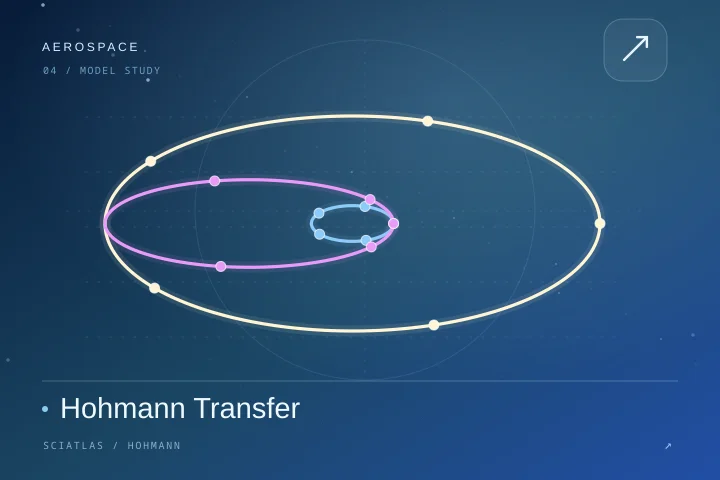
Hohmann Transfer
calculates the speed increment and time of double pulse transfer between coplanar circular orbits.
Earth two bodies, instantaneous pulse, no orbital inclination change.
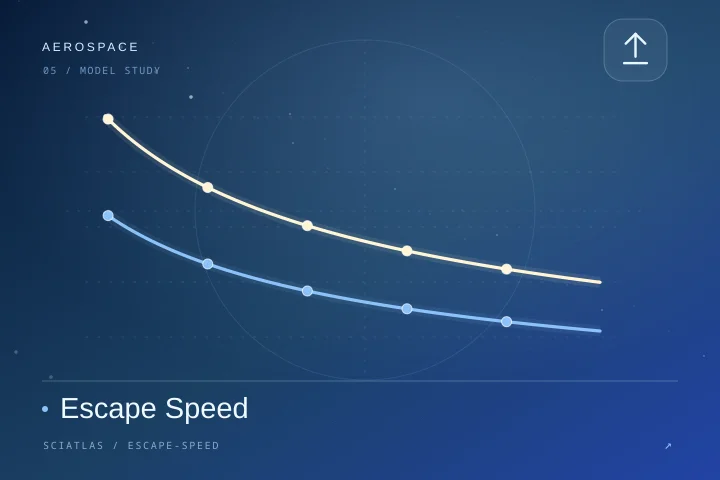
Escape Speed
Compares the circular orbit velocity and escape velocity according to the gravitational parameters of the central celestial body.
is an isolated spherically symmetric celestial body, excluding atmosphere, rotation and third body.
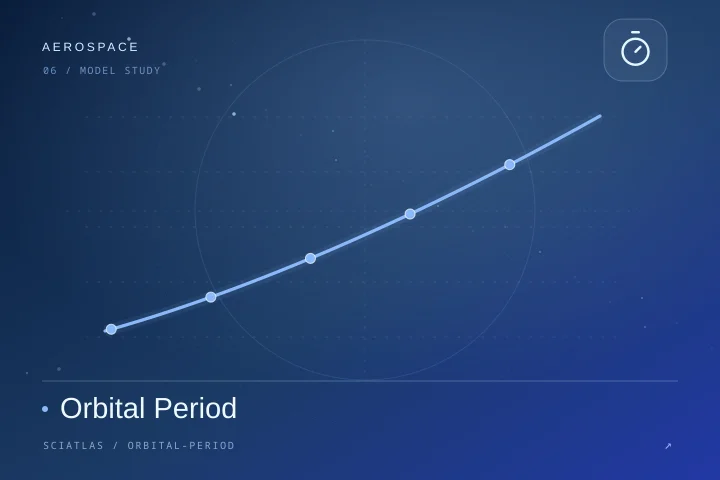
Orbital Period
calculates the period from the semi-major axis of the orbit, or finds the synchronization radius based on the specified period.
Two-body elliptical orbit; synchronization radius needs to be understood in conjunction with the rotation period.

J2 Secular Rates
estimates the long-term drift of the ascending node and perigee caused by the Earth's oblateness.
First-order J2 average perturbation, non-precision propagation.
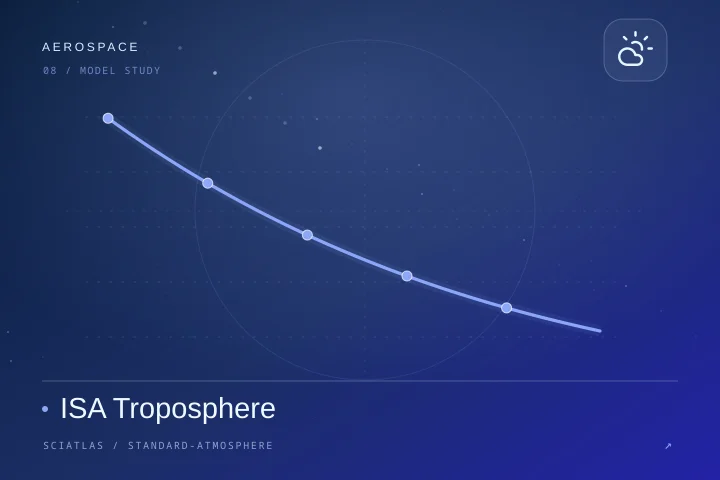
ISA Troposphere
estimates 0–11 km standard atmospheric temperature, pressure, density and sound speed.
ISA Dry air, linear lapse rate, troposphere only.

Free-space Link Budget
calculates path loss, received power and receive threshold margin.
free space line of sight, far field, does not include rain attenuation, multipath and polarization losses, additional losses must be input by yourself.
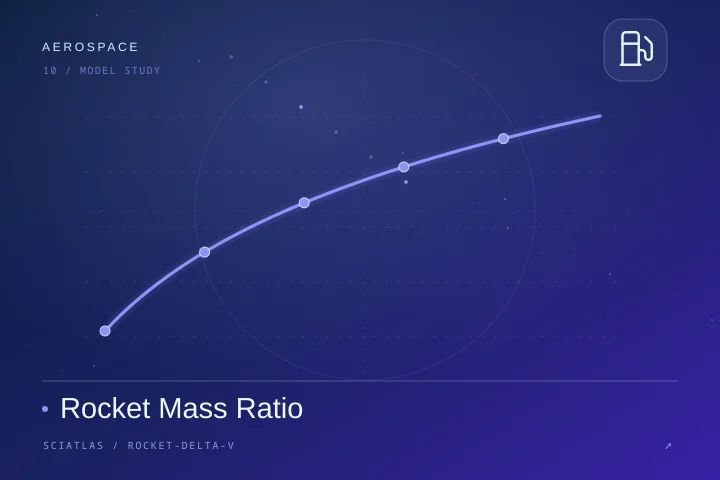
Rocket Mass Ratio
Calculates the ideal single-stage velocity increment to propellant mass ratio.
Constant specific impulse, no gravity and resistance loss.
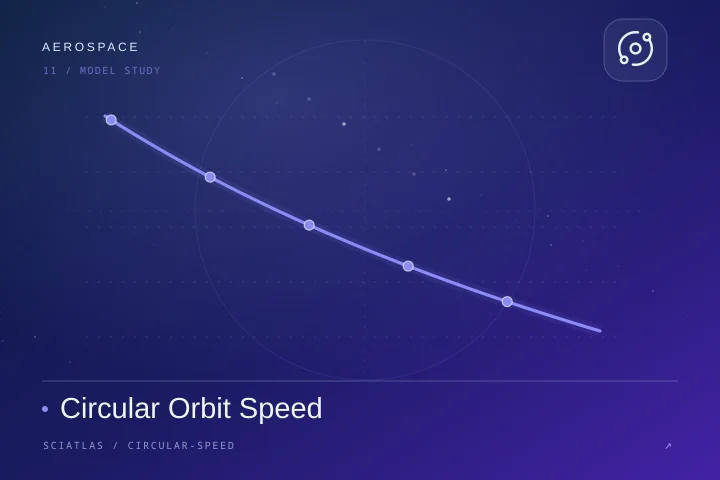
Circular Orbit Speed
v=√(μ/r): Calculate the circular orbit velocity based on the input, and provide local sensitivity curves and data export.
Central gravitational circular orbit, without perturbation.
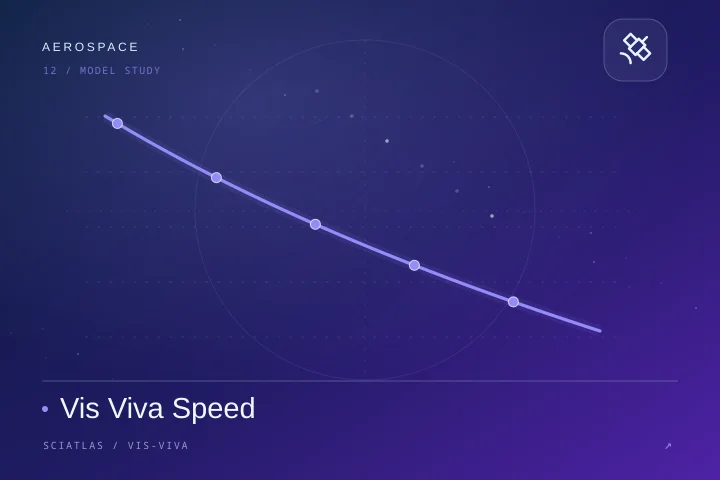
Vis Viva Speed
v=√[μ(2/r−1/a)]: Calculate the instantaneous velocity of the elliptical orbit based on the input, and provide local sensitivity curves and data export.
Two-body elliptical orbit, the radius must meet the defined root sign and be consistent with the set orbit.
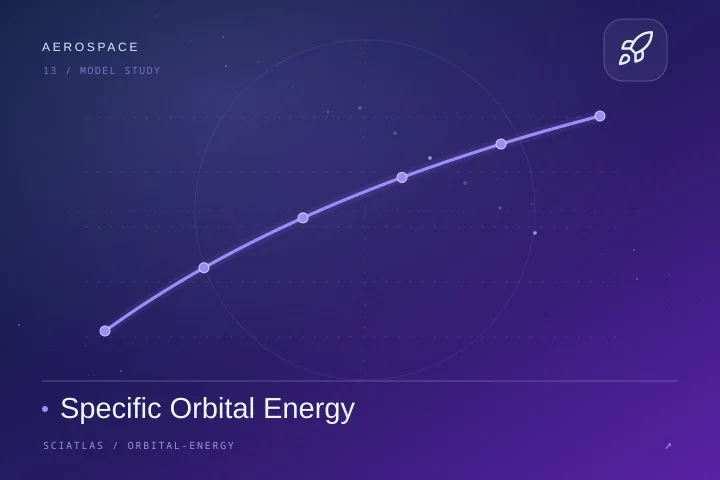
Specific Orbital Energy
ε=−μ/(2a): Calculate the orbital specific mechanical energy based on the input, and provide local sensitivity curves and data export.
is only used to constrain the elliptical orbit, and the potential energy zero point is taken to infinity.

Specific Angular Momentum
h=√[μa(1−e²)]: Calculate the orbital specific angular momentum based on the input, and provide local sensitivity curves and data export.
two-body elliptical orbit.

Periapsis Radius
rp=a(1−e): Calculate the periapsis radius based on the input, and provide local sensitivity curves and data export.
Elliptical orbit geometric relationship; need to check whether it is lower than the surface of the celestial body.

Apoapsis Radius
ra=a(1+e): Calculate the apoapsis radius according to the input, and provide local sensitivity curve and data export.
elliptical two-body orbit.

Plane Change Delta-v
Δv=2v sin(Δi/2): Calculate the orbit plane orbit change speed increment based on the input, and provide local sensitivity curves and data export.
Pure plane instantaneous orbit change at the same position, the speed before and after the orbit change is the same.

Synodic Period
Ts=1/|1/T₁−1/T₂|: Calculate the orbit rendezvous period based on the input, and provide local sensitivity curves and data export.
is a nearly circular orbit in the same direction; the same period has no finite rendezvous period.

Sphere of Influence
rSOI=a(m/M)^(2/5): Calculate the Laplacian action sphere based on the input, and provide local sensitivity curves and data export.
Spliced conic approximation, non-strict dynamic boundary.

Hill Radius
rH=a(1−e)(m/3M)^(1/3): Calculate the Hill sphere radius based on the input, and provide local sensitivity curves and data export.
Small mass ratio approximation; long-term stable satellite orbits are usually smaller than the Hill radius.
Horizon Footprint
s=R acos[R/(R+h)]: Calculate the satellite horizon coverage radius based on the input, and provide local sensitivity curves and data export.
Surface arc length of a spherical body, zero minimum elevation angle, and no refraction.
Flight Dynamic Pressure
q=ρv²/2: Calculate flight dynamic pressure based on input, provide local sensitivity curve and data export.
The definition of local flow field dynamic pressure is not equal to the pressure increment of the compressible flow stagnation point.

Aerodynamic Lift
L=ρv²SCL/2: Calculate wing lift based on input, provide local sensitivity curve and data export.
lift coefficient needs to match the angle of attack, Mach number and Reynolds number.

Aerodynamic Drag
D=ρv²SCD/2: Calculate aerodynamic resistance based on input, and provide local sensitivity curves and data export.
The definition of reference area and resistance coefficient must be consistent.

Stall Speed
Vs=√[2W/(ρSCLmax)]: Calculate stall speed estimation based on input, provide local sensitivity curve and data export.
has a level flight load factor of one and cannot replace airworthiness performance data.
Ideal Gas Sound Speed
a=√(γRT): Calculate the ideal gas sound velocity based on the input, and provide local sensitivity curves and data export.
is a thermal perfect gas, R is the mass ratio gas constant.

Mach Number
M=v/√(γRT): Calculate speed to Mach number based on input, provide local sensitivity curve and data export.
uses the local gas sound velocity and does not include the real gas high temperature effect.
Stagnation Temperature
T₀=T[1+(γ−1)M²/2]: Calculate the relationship between total temperature and static temperature based on the input, and provide local sensitivity curves and data export.
Adiabatic, no shaft work, constant specific heat ideal gas; fails when dissociated at high temperature.

Rocket Mass Flow
ṁ=F/(Isp g₀): Calculate rocket propellant flow rate based on input, provide local sensitivity curve and data export.
The given effective specific impulse includes the influence of the nozzle pressure in the environment.

Ballistic Coefficient
β=m/(CDA): Calculate the re-entry ballistic coefficient based on the input, and provide local sensitivity curves and data export.
Preliminary reentry model with fixed mass and area and approximately constant drag coefficient.
Understand the method and then start calculating
Tools in this field provide runnable examples, model conditions and method descriptions. Please select a model that meets the experimental conditions and retain parameter and version information.
Connect knowledge with each other
Related disciplines and tools In the initial calculation of
Mechanical Engineering ↗Structural load and mechanism motion
Cryptography ↗Satellite Communication and Data Certification The
Mathematics ↗Orbit estimation and numerical calculation