Agronomy & Climate
From questions to insights, 30online scientific tool. No registration required, free calculation and export.

ET₀ & Irrigation
uses the FAO-56 daily scale model to estimate crop water consumption and net irrigation.
Daily scale reference evapotranspiration; input net radiation and 2 m wind speed. Single crop coefficients, without complex root zone/salt model.

Greenhouse Climate
Observe the relationship between ventilation intensity and temperature distribution under restricted geometry.
A two-dimensional steady-state convection-diffusion thermal model driven by a fixed fan jet parameter field; 3D is a transverse uniform extrusion display. Without solving Navier–Stokes, engineering CFD predictions cannot be made.

Soil Water Balance
combines actual measurement points and daily weather to estimate root zone water deficit.
measuring point spatial map uses inverse distance weight interpolation; the daily forecast uses a simplified bucket model. Weather comes from user input, with no pretense of access to real-time forecasts.

Dew Point
estimates dew point using temperature and relative humidity.
Magnus Approximate water surface, air temperature 0–50 °C; low temperature ice conditions are not applicable.

Vapor Pressure Deficit
calculates saturated vapor pressure, actual vapor pressure and deficit.
is based on the input air temperature and humidity, which is not equal to the VPD corresponding to the blade temperature.

Growing Degree Days
Cumulative growing degree days from daily maximum and minimum temperatures.
Simple daily average temperature method; the upper limit cutoff is first applied to the daily average temperature; the applicable crop base temperature needs to be selected.
Irrigation Runtime
estimates run time based on clear water depth, area, efficiency and system flow.
Uniform irrigation within the area, constant flow; does not include infiltration constraints and pipe network hydraulic calibration. Page

Nutrient Mass Balance
converts the target effective nutrient amount into product application amount.
Single nutrient mass balance, nutrient benchmarks must be consistent (elements and oxides cannot be mixed).
Root-zone Available Water
Calculate available water and trigger deficit from field water capacity, wilting point and root depth.
has uniform root zone volume moisture content and fixed root depth; does not simulate soil layer differences and capillary rise.

Solar Geometry
calculates theoretical day length and atmospheric radiation according to latitude and day sequence.
FAO-56 diurnal scale geometric approximation, dealing with extreme day and night; does not include cloud cover and terrain obstruction.
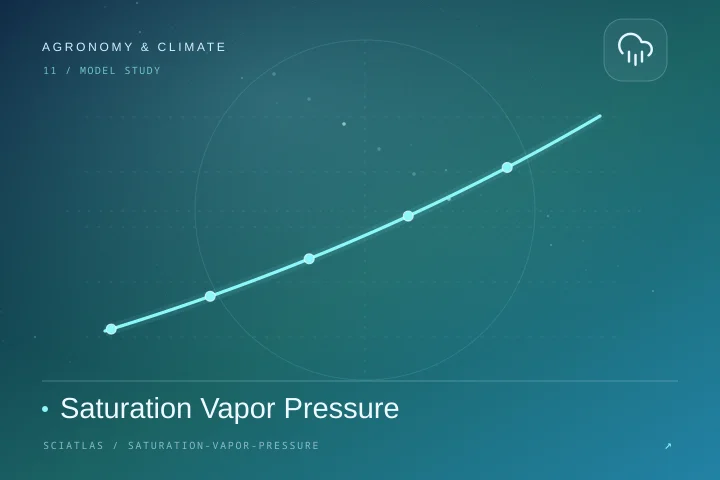
Saturation Vapor Pressure
es=0.6108exp(17.27T/(T+237.3)): Calculate the saturated water vapor pressure based on the input, and provide local sensitivity curves and data export.
FAO commonly used temperature range approximation, different relationships are used for subzero ice surfaces.
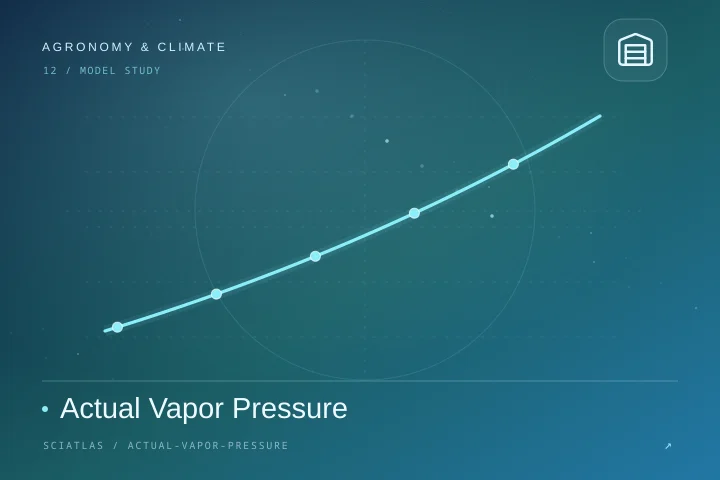
Actual Vapor Pressure
ea=RH·es/100: Calculate the actual water vapor pressure based on the input, and provide local sensitivity curves and data export.
The temperature and relative humidity at the same measuring point, and the saturation pressure are approximated by the water surface.
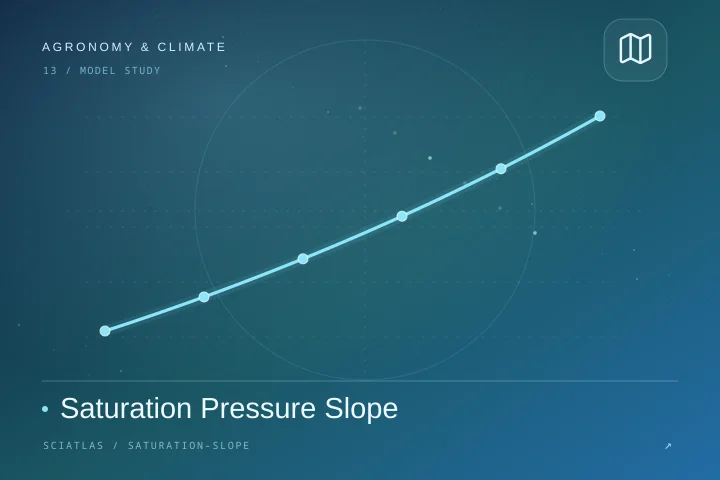
Saturation Pressure Slope
Δ=4098 es/(T+237.3)²: Calculate the slope of the saturated water vapor pressure curve based on the input, and provide local sensitivity curves and data export.
FAO Reference to the local slope used in evapotranspiration.

Psychrometric Constant
γ=0.000665P: Calculate the psychrometer constant based on the input, and provide local sensitivity curves and data export.
is a commonly used approximation in agricultural meteorology, and the latent heat of water vaporization is approximately constant. The
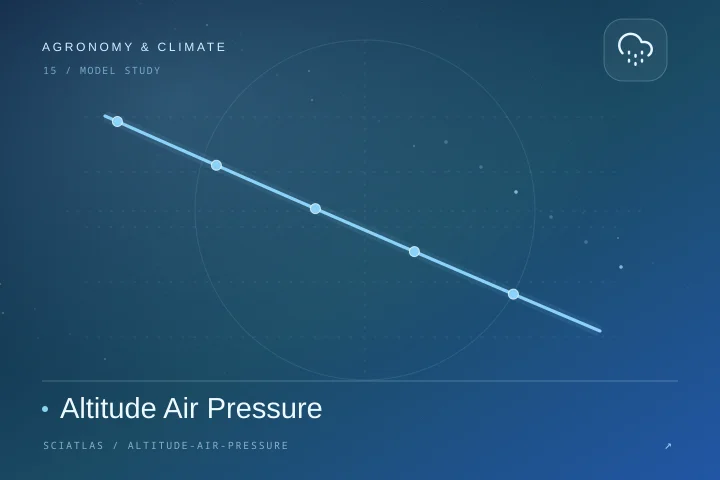
Altitude Air Pressure
P=101.3[(293−0.0065z)/293]^5.26: Calculate altitude pressure estimation based on input, and provide local sensitivity curves and data export.
FAO Agricultural meteorological altitude pressure is approximate and not equal to real-time weather pressure.

Crop Evapotranspiration
ETc=Kc ET₀: Calculate crop evapotranspiration coefficient conversion based on input, and provide local sensitivity curves and data export.
has no water stress conditions, and Kc needs to match the growth period and planting conditions.
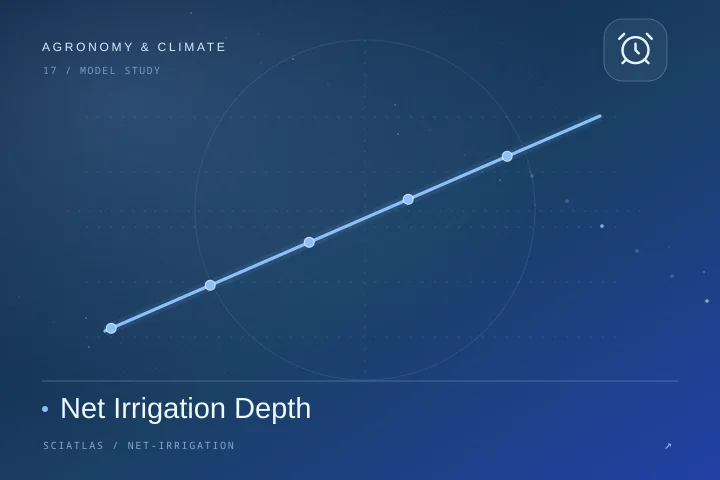
Net Irrigation Depth
Dn=(θtarget−θcurrent)Zr: Calculate the net irrigation water depth in the root zone based on the input, and provide local sensitivity curves and data export.
has a uniform root zone and does not contain deep runoff and precipitation.
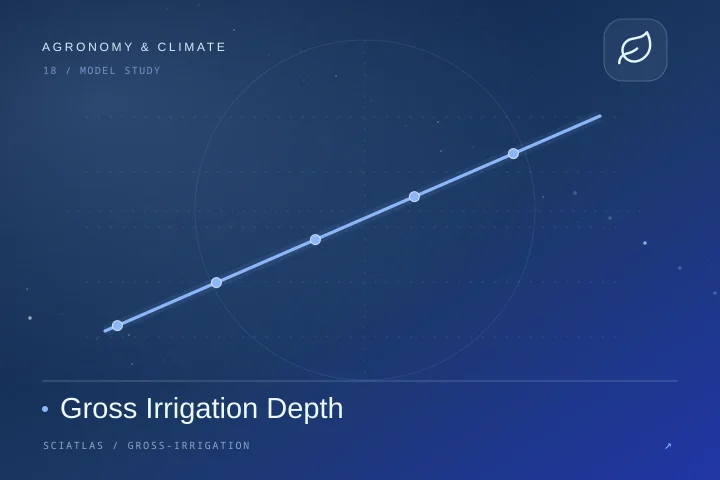
Gross Irrigation Depth
Dgross=Dnet/η: Calculate the irrigation efficiency and gross irrigation volume based on the input, and provide local sensitivity curves and data export.
overall efficiency is calibrated in the field without splitting individual loss processes.
Irrigation Water Volume
V=A D×10: Calculate the area irrigation volume based on the input, and provide local sensitivity curves and data export.
Geometric conversion of uniform irrigation, 1 ha·mm=10 m³.
Soil Water Storage
S=θZ: Calculate root zone soil water storage based on input, and provide local sensitivity curves and data export.
Uniform soil layer and stratified soil should be accumulated separately.
Gravimetric to Volumetric
θ=wρb/ρw: Calculate the mass volume moisture content conversion based on the input, and provide local sensitivity curves and data export.
is 1000 kg/m³; the upper limit of porosity still needs to be checked.

Soil Porosity
φ=1−ρb/ρs: Calculate soil bulk density porosity based on input, and provide local sensitivity curves and data export.
Organic matter and mineral composition affect soil particle density.
Water Filled Pore Space
WFPS=θ/φ: Calculate the water-filled pore ratio based on the input, and provide local sensitivity curves and data export.
The volumetric moisture content shall not exceed the set porosity.
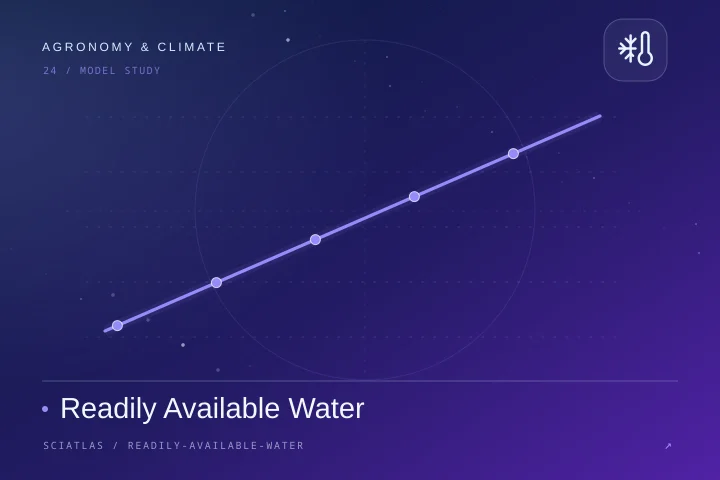
Readily Available Water
RAW=p·TAW: Calculates easy-to-use soil water based on input, and provides local sensitivity curves and data export.
ratio p varies according to crop, climate and evapotranspiration requirements.
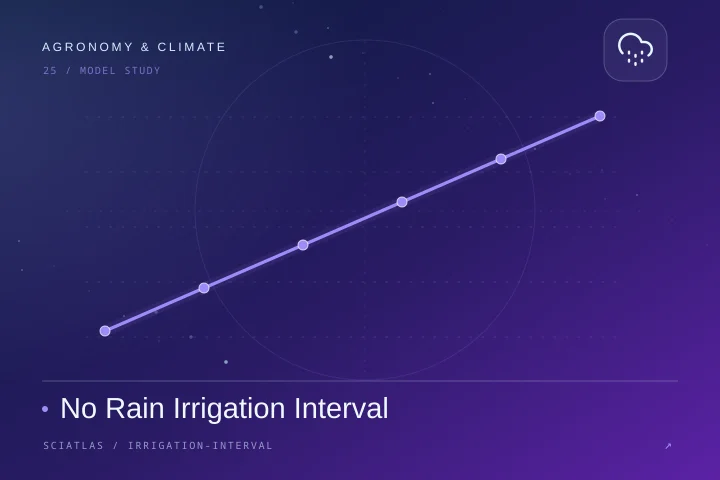
No Rain Irrigation Interval
interval=RAW/ETc: Calculate the rainless irrigation interval based on the input, and provide local sensitivity curves and data export.
Preliminary estimate of fixed ETc, no rain, no capillary recharge.
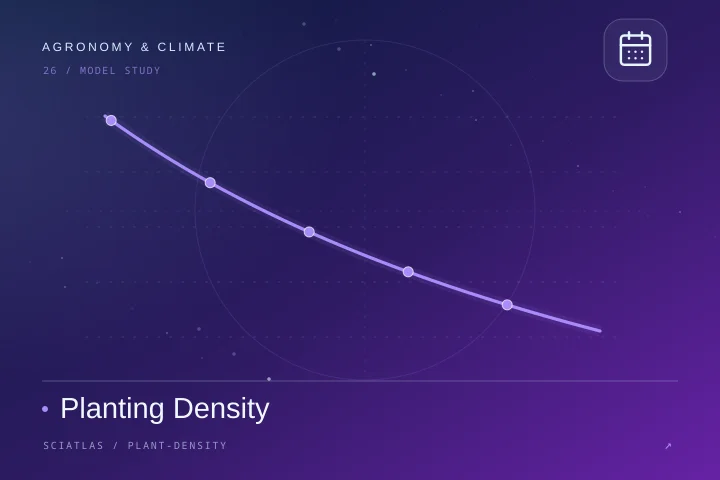
Planting Density
N=10000/(row·plant): Calculate the plant-row spacing planting density based on the input, and provide local sensitivity curves and data export.
The rectangles are arranged evenly, without excluding roads and missing trees.

Seed Rate
mass=N·TKW/(germ·purity·10⁶): Calculate the target seedling number and seeding rate based on the input, and provide local sensitivity curves and data export.
Assume that indoor germination rate is equal to seedling establishment rate; additional correction is required for field losses.

Leaf Area Index
LAI=leaf area/ground area: Calculate leaf area index based on input, provide local sensitivity curve and data export.
The definition of single-sided leaf area, excluding branches, and the definition of needles needs to be agreed separately.
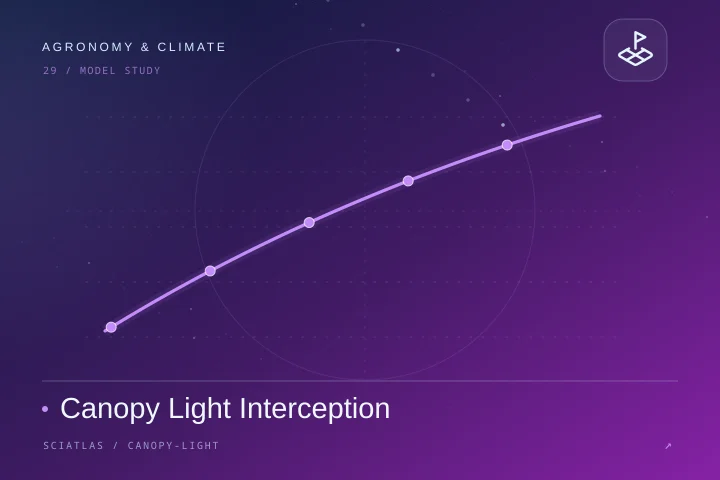
Canopy Light Interception
f=1−exp(−k LAI): Calculates canopy light interception based on input, providing local sensitivity curves and data export.
Beer-type uniform canopy approximation, without distinguishing between direct radiation and scattering.
Greenhouse Air Changes
ACH=Q/V: Calculate the number of greenhouse air changes based on the input, and provide local sensitivity curves and data export.
Ideal mixed volume ventilation does not represent local flow field or temperature and humidity uniformity.
Understand the method and then start calculating
Tools in this field provide runnable examples, model conditions and method descriptions. Please select a model that meets the experimental conditions and retain parameter and version information.
Connect knowledge with each other
Related disciplines and tools In the initial calculation of
Earth & Geophysics ↗Soil moisture and groundwater
Chemical Engineering ↗Heat and mass transfer and greenhouse environment
Biochemistry ↗Crop nutrition and metabolism