DMG MORI DMU 50 five-axis machining center
is a five-axis milling equipment used for complex parts processing, supporting multi-facet and curved surface processing.
What science makes it possible The
kinematic transformation maps the tool path to machine tool axis motion. Stiffness, thermal deformation and vibration jointly affect surface quality; material cutting behavior and process parameters need to be determined independently.
Understanding the product requires putting a single formula back into the system: input measurements, materials and boundary conditions are calculated by the model and then compared with actual data. Approximations at different scales cannot be unconditionally spliced, and relevant tools will indicate applicable conditions respectively.
Commercial applications and engineering boundaries
Aerospace and precision mold companies use five-axis equipment to reduce clamping and process complex surfaces. The tools on this site are used for mechanical magnitude understanding and cannot directly output verified production tool paths.
is an independent technical interpretation based on the manufacturer's public information and does not represent the manufacturer's adoption, endorsement or sponsorship of SciAtlas. The illustrations are original illustrations of the principles of this site, not photos of the actual products. Product specifications, certifications and availability are subject to the manufacturer's current information; the relevant tools only demonstrate public simplified models.
Manufacturer’s products and official information ↗Use online tools to understand related issues
Constrained Thermal Stress
One-dimensional fully constrained, compressive stress is generated by heating; plasticity and temperature-dependent modulus are ignored.
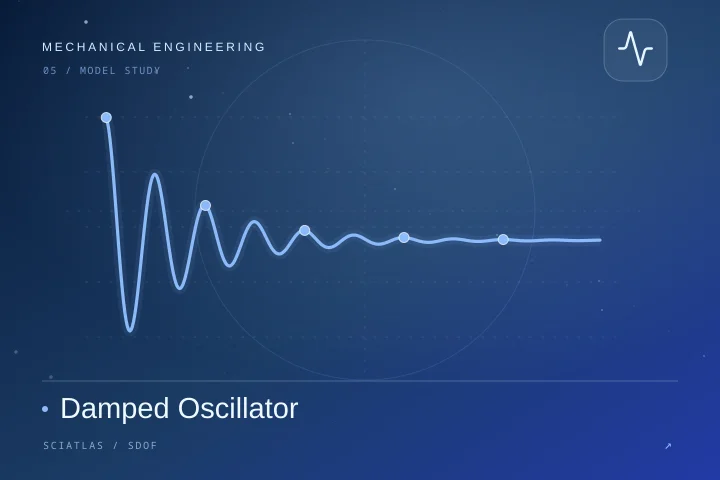
Damped Oscillator
linear mass-spring-damping model, 0≤ζ<1, initial velocity is zero.
Shaft Power
Steady state rotation, no energy storage transient.
Linear System Solver
Up to 50th order real square matrix; pathological system prompts unreliability.
linked model is used for independent learning and magnitude analysis and does not copy the manufacturer's proprietary software or pass product performance certification.
People and historical contributions behind the science
The following relationships distinguish theoretical and method pioneers and industry leaders; it does not mean that these figures independently invented the product on this page.
made extensive contributions to mechanics, differential equations and number theory, and Euler buckling and rigid body dynamics are still used in engineering teaching.
Joseph FourierJoseph Fourierdevelops heat conduction theory and Fourier analysis, and establishes mathematical tools for heat transfer, spectral analysis and imaging calculations.
Related Elements and Materials Basics
elemental portal is for understanding related materials or molecular basis and does not claim a complete materials list for a specific model.