Industry Application · Independent Reproduction Example
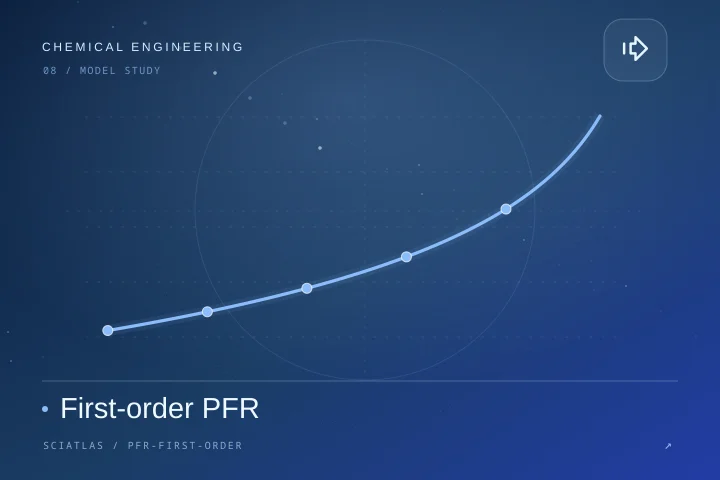
First-order PFR
The reaction engineering team compares the volume requirements of tubular and kettle reactors.
Public industry reference: MIT · Department of Chemical Engineering
The institution’s public research directions include: Reaction engineering, separation, thermodynamics and process systems. This link serves as a portal for field background and extended learning.
Load the default example of First-order PFR and check rate constant、target conversion rate、volume flow and its units.
is calculated using τ=−ln(1−X)/k; V=Qτ, and the results are compared after adjusting a single parameter.
checks applicable conditions and diagnostics, and exports numerical tables, charts, and model versions for review.
Deliverables
Calculate the residence time and volume of an ideal plug flow reactor. delivers parameter records, calculation charts, and reproducible JSON result packages.
case is compiled for public industry purposes, and the reproduction steps are independent examples of this site; it does not mean that the above-mentioned institutions use or endorse this site, nor does it cite customer benefits that have not been publicly verified.
The
SEE THE PRINCIPLE IN MOTION
scientific animation demonstration
Scroll to load calculation example…
FOLLOW THE RESEARCH
recommended by universities and research institutions
Chemical Engineering
The following is the recommended reading order of this website organized by direction relevance, public research resources and learning portals. The number is the serial number recommended by the editor, not QS, THE or paper measurement ranking; it does not represent the overall strength of the institution.
Chemical Thermodynamics, Transfer and Reaction Engineering。
official website entrance; please refer to the current public page of the institution.
catalog compiled on 2026-10-03. Link accessibility does not equate to verification of the latest papers, admissions, or program status; please check the institution's official website for specific research teams and opportunities.
CONNECTED SCIENCE
Connect knowledge with each other
Related disciplines and tools
In the initial calculation of